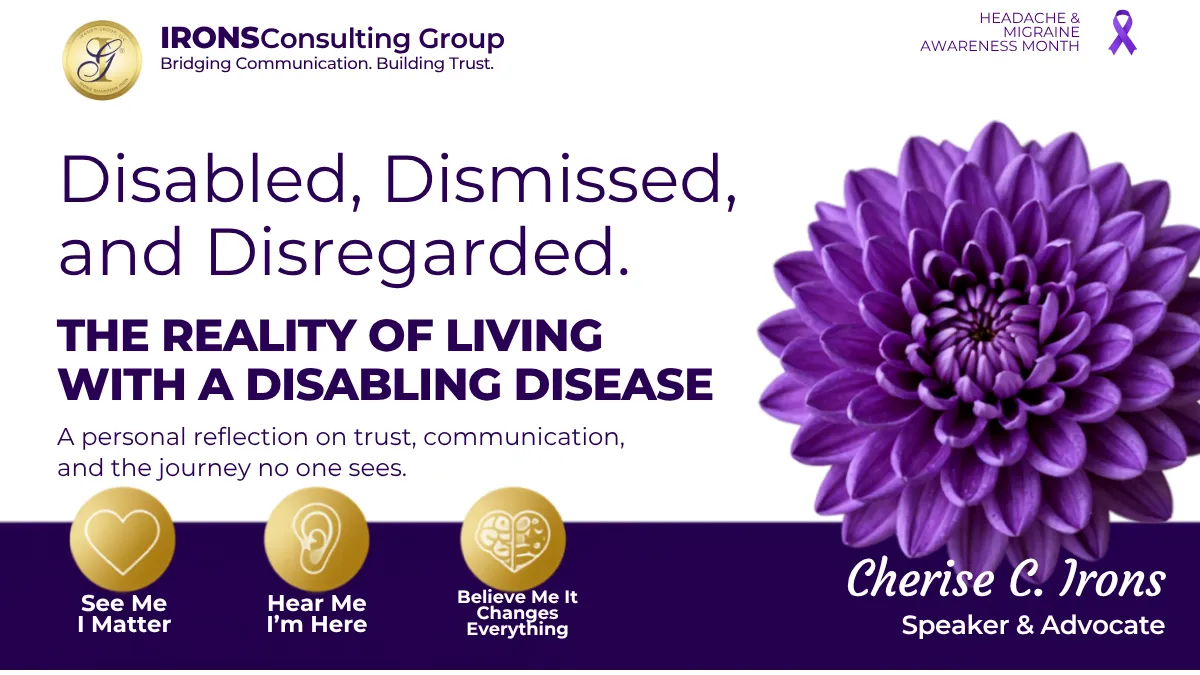
Disabled, Dismissed, Disregarded
"Just breathe."
"It's probably stress."
"We don't have any appointments for three months."
Individually, these moments may seem small. But for someone living with chronic illness, they stack up. They quietly erode trust, increase anxiety and over time, they leave a person feeling exactly what the title of this article says.
Disabled. Dismissed. Disregarded.
This is my reality and that of millions of people living with migraine disease the second leading cause of disability worldwide.
Calling 911 Again
I want to tell you about a recent ER visit that was filled with lessons and confirmed why my work is necessary.For days, I had been experiencing chest pain and for days, I hesitated.
If you live with chronic migraine, you already know why.The ER is loud, overstimulating, covered in fluorescent lights, and relentlessly fast-paced. It is, in almost every way, the perfect environment to trigger a migraine attack.This was that last thing I needed on top of whatever was already happening in my chest. So, I chose to wait and manage my pain on my own until I couldn’t.Two minutes after that 911 call, EMTs were at my door, and I was on my way to the hospital with chest pain as the primary concern. As the EMT’s asked me questions and keep me alert I said a quiet prayer in the back of my mind: Lord, please don't let this become a migraine too.
To my surprise, the ER process was smooth.I was assigned a room quickly, tests were ordered, and the staff moved efficiently.I really appreciated this because my anxiety decreased.Although, the test results were showing no issues, the ER doctor decided to admit me for observation because she wanted to ensure nothing was missed. Here is where things shifted.
The transition from the ER to the floor was smooth.The night shift picked up where the ER left off; however, communication shifted with the morning staff.The student nurse and other staff members seemed to be out of sync.The cardiologist rushed in did a quick check and rushed out with a “you don’t need me.”I was totally grateful my results weren’t a problem; however, it was extremely dismissive.Then another doctor prescribed medications without ever speaking to me. I informed the nurse that I would like to see the doctor to determine the diagnosis and reason for the prescription.Her response was direct: “Google it.” or use “ChatGPT”
Let that sit for a moment.
A patient in a hospital bed advocating for herself being told to Google information about medications prescribed to her body. It was a student pharmacist, to his great credit, who sat with me, explained the medication, and asked about my experience. He was kind,apologetic, thorough and present.I eventually saw the doctor who gave me her reason for the medication and told me I could go home.Again, I was left waiting for hours with no communication about what came next.The charge nurse eventually came in to ask, do you know you can go home.”My response: “Yes; however, the nurse left and never returned.”I had to use the call button for the nurse to come in.I was eventually discharged.
This contrast tells you everything you need to know about where communication gaps live in healthcare.
When the System Becomes Part of the Burden
Stephen M.R. Covey writes in The Speed of Trust: "Trust is the one thing that changes everything."He is right and nowhere is that truer than in healthcare. Living with chronic migraine has taught me that the hardest part of illness is not always the pain. Sometimes it is everything required to access effective care. It is arranging transportation when you cannot drive,sitting in a vehicle that arrives late, waiting months to see a specialist, and explaining your story to provider after provider who do not communicate with one another. It is summoning the courage to describe your symptoms and then feeling rushed, minimized, or dismissed. By the time many patients finally reach the exam room, they are already exhausted before the appointment begins.
The Emotional Cost of Repeated Dismissal
There is a specific kind of distress that happens when you know something is wrong and the people responsible for your care minimize it.
I know this firsthand.
There were moments in my migraine journey when my symptoms were overlooked and delays in receiving care appropriate care led to more significant changes. Those experiences leave a mark. You question your own judgment, wonder if you are overreacting, and you walk into every appointment already on edge and ready to defend the reality of your life.Over time, that emotional burden compounds and frustration can evolve into anxiety, hypervigilance, and a deep sense of helplessness.
Covey also writes: “We judge ourselves by our intentions and others by their behavior."Patients are not judging providers harshly out of unreasonable expectations. They are responding to behavior and what happened in the room.That experience matters more than many clinical leaders realize.
Disabled. Dismissed. Disregarded.
Disabled:Chronic migraine affects cognition, mobility, employment, and daily functioning. Many of us carry disabilities that others can’t see.
Dismissed: Symptoms are minimized, concerns are deflected, and patients are told it is stress, anxiety, or something they should just manage better.
Disregarded: Poor communication, long wait times, and systemic barriers communicate the same message: Your suffering is not urgent.When this pattern repeats, the impact both physical and psychological.
What Healthcare Leaders Need to Understand
If you are a healthcare executive, clinical leader, or practice owner this article is not about blame or even a us against them. It about an awareness.An awareness that can restore dignity and compassion to the patient-provider relationship.
Many of the challenges leaders are trying to solve patient dissatisfaction, poor reviews, communication breakdowns, and strained staff interactions are rooted in how care is experienced.The concern that goes unaddressed, the medication prescribed without any conversation, the ack of communication that leaves a patient waiting for hours with no information.Each of those moments sends a message. Sometimes the message received is: "You do not matter enough for my full attention."
Covey says it plainly: "You can't talk your way out of a problem you behaved your way into."the Mission statements cannot repair what daily interactions repeatedly damage.
What Leaders Can Do Starting Now
The good news is that meaningful change does not always require a massive initiative. It often starts with small, intentional shifts in culture and communication.
What if you:
1.Trained teams to validate concerns before offering solutions.
Patients need to feel heard before they can trust the plan.
2.Eliminated unnecessary friction in scheduling and follow-up.
Every barrier communicates something.
3.Recognized transportation and access as part of the patient experience.
These challenges do not disappear because they fall outside traditional clinical care.
4.Encouraged proactive communication across specialties.
Patients should not have to serve as the communication bridge between providers.
5.Created a culture where dignity is embedded in every interaction.
From the front desk to the discharge instructions, every touchpoint matters.
These are not revolutionary ideas.They are foundational practices that separate organizations that treat illness to those that help people heal.
Personal Reflection
My journey as a migraine patient, mother, and advocate has taught me one thing above all else: what patients need most is often simple:
To be seen
To be heard
To believed.
I am one of the many women whose life has been profoundly altered by chronic migraine. It has affected my cognition, career, finances, relationships, and daily functioning. I have experienced compassionate care.I have experienced moments of dismissal that communicated my suffering was inconvenient rather than important.I have also faced indifference which can leave a deeper mark than intentional harm.
I share this not to invite pity instead to educate. If someone like me, an educated professional and advocate continually encounters these barriers, imagine the patient who does not know her rights, lacks the language to advocate for herself, or simply does not have the energy left to keep pushing. This is why I do this work.
I partner with healthcare leaders to bridge communication gaps so that patients living with chronic migraine feel genuinely supported, and clinical teams have the practical tools to improve trust, outcomes, and the overall care experience.
A Closing Invitation
This Migraine and Headache Awareness Month, I invite every healthcare leader to sit with one question:
What does your system feel like to the person moving through it?
The quality of a healthcare organization is not revealed only by its outcomes. It is revealed by how it treats people when they are most vulnerable.I am one of those patients and I cannot stay silent.
Change begins when patients no longer feel disabled, dismissed, and disregarded.
Awareness starts the conversation and action changes the experience.
Ready to bring better communication and patient-centered culture to your organization? Let's connect.
#MigraineAwarenessMonth #ChronicMigraine #HealthcareLeadership #PatientExperience #RiseAboveMigraine #IronsConsultingGroup #ServantLeadership #HealthcareInnovation


