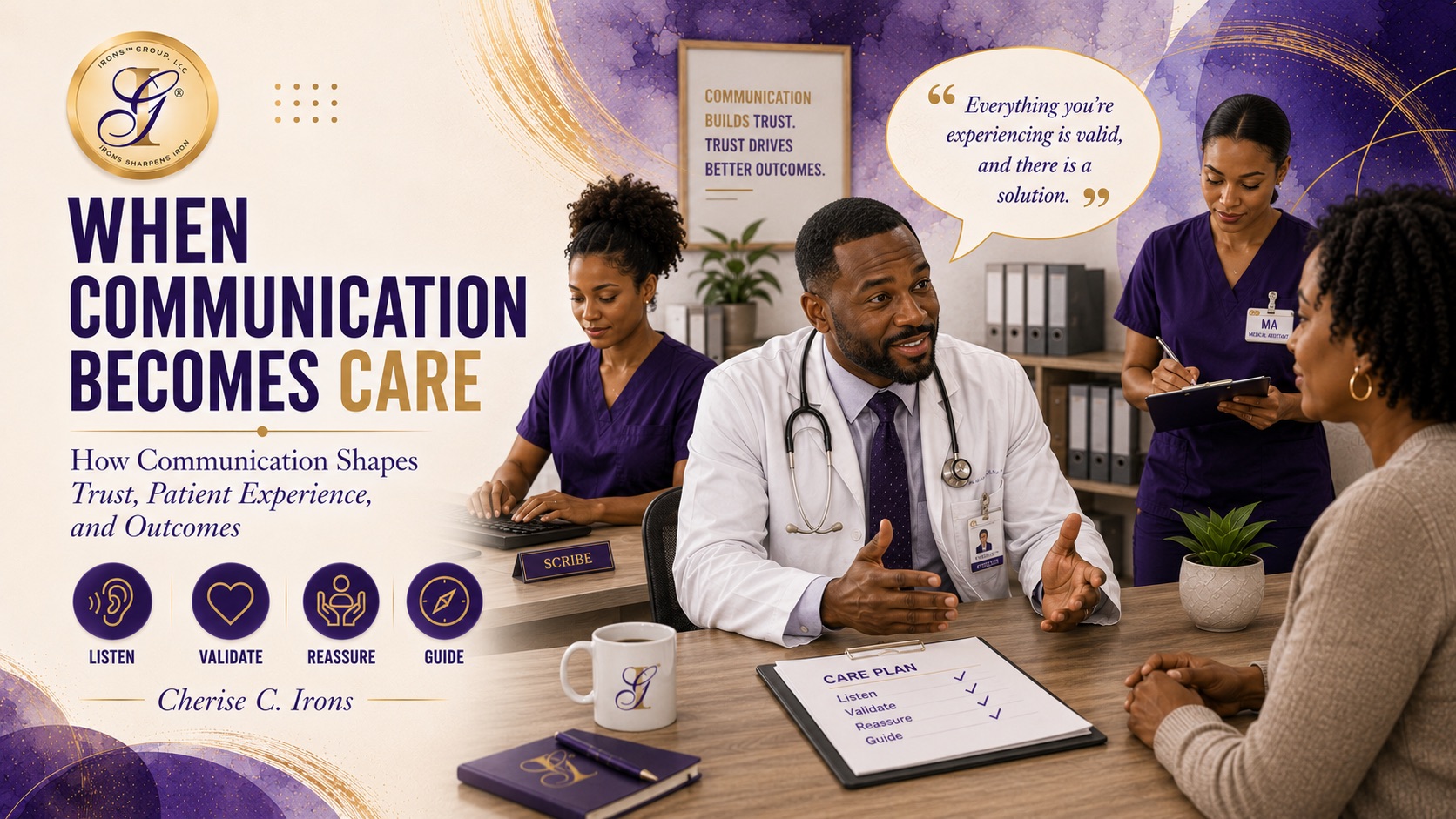
When Communication Becomes Care
When Communication Becomes Care: The Hidden Link Between Patient Trust and Healthcare Outcomes
By Cherise Irons
Have you ever wondered how two patients can walk into a doctors office see the same provider, receive the same diagnosis, treatment plan, yet have vastly different experiences? One patient leaves feeling seen, heard, supported and hopeful while the other walks away feeling dismissed, uncertain and stigmatized.
What changed between patients? I believe it boils down to one word:
Communication.
It isn't the diagnosis, treatment plan, or clinical expertise it is how each patient experiences the conversation.
Throughout this Migraine and Headache Awareness Month series, I have shared the realities of living with chronic migraine and the hidden costs that often go unseen. In my first article, I shared the experience of feeling disabled, dismissed, and disregarded while navigating healthcare. In my second article, I examined the economic, workforce, and societal costs of migraine that rarely appear in reports or statistics. This article focuses on Communication because we cannot separate this from care models especially with the patients that are the most vulnerable. How does one deliver care effectively without proper communication?
What Is Communication?
For many people communication may be about sending direct messages to a friend, texting, engage in a phone conversation, share something on social media, or simply the exchange of information. In healthcare, communication is much more than that. It can mean the difference between life and death.
Communication is the intentional exchange of information, understanding, and empathy that helps another person feel informed, valued, and supported. In other words: Communication is not just what we say. It is what the other person experiences when we say it. How are you delivering the information and how is it impacting the hearer?
Many healthcare organizations spend significant time improving systems, processes, technology, and clinical outcomes. Yet patients experience healthcare through their interactions with humans. They experience it through conversations, the words chosen, questions asked, explanation provided, empathy demonstrated, and how trust is built.
When Communication Is Done Well
Earlier this week, I sat in a physician's office seeking answers regarding a medical issue that has created uncertainty, stress, and growing anxiety. As a patient navigating a complex healthcare journey, I arrived with questions, concerns, and fears about what the future might hold. The physician could have immediately begun discussing procedures, risks, diagnostic findings, or next steps. Instead, he began with a simple statement: "Let me start with the end and then go to the beginning. Everything you are experiencing is valid, and there is a solution."
The comment though brief had a profound impact on how to appointed proceeded. There was nothing that had changed about the diagnosis, no treatment was performed or procedure scheduled. What changed was my experience and how the specialist chose to deliver difficult test results to me. His approach decreased my anxiety, stress, and my confidence increased. My feelings were validated and I felt heard, understood, and hopeful.
That is the power of communication. The physician did more than share test results, he showed genuine compassion, acknowledged my reality and validated all concerns. He created an environment of trust before discussing treatment. In that moment, communication became part of the care itself.
The Difference Between Communicating and Connecting
In Everyone Communicates, Few Connect, John Maxwell writes: "Connecting increases your influence in every situation." The difference between communication and connection is one healthcare leaders should not overlook.
Communicators transfer information while connectors create understanding.
Communicators explain while connectors engage.
Communicators talk while connectors build trust.
Most patients arrive to doctors appointments having done their own research because they have access to an abundance of information. Patients do not simply need more information. What they need is a healthy doctor- patient relationship one that is filled with understanding, context, reassurance, and someone who recognizes that receiving healthcare information while anxious, overwhelmed or in pain is very different from receiving information under ordinary circumstances.
Here is something to consider:
A patient with chronic migraine has often already searched every symptom, read every forum, and rehearsed every question before walking through your door. They are not uninformed. They are exhausted from years even decades of advocacy without feeling truly heard. That changes how we should think about the conversation. Before patients can trust recommendations, they need to trust the person delivering them. That trust begins with real connection.
The Trust Equation
Trust isn't built overnight or from one extraordinary interaction. It is built through many ordinary moments. For example, a provider who enters the exam room introduces themselves, their team, and extends a hand, a provider who sits rather than stands over a patient, a nurse taking an extra moment to reassure and answer questions, a scheduler acknowledging a patient's frustration, a physician explaining not only what is happening but why it matters and a team member saying: "I understand why you're concerned." These moments may seem small; however, to patients they are not.
Patients always remember how they were treated when they were most vulnerable. They may forget portions of a treatment plan, but remember how a healthcare professional made them feel.
How does trust grow? Trust grows when patients feel seen, heard, understood, and respected.
How does trust decline? rust declines when patients feel rushed, dismissed, and invalidated,
For patients living with chronic migraine, this dynamic carries extra weight. Many have walked into appointments having already been told for years that their pain is exaggerated, stress-related, or not as serious as they describe. They have been handed a pamphlet, offered a prescription when validation and a conversation was needed.
By the time many migraine patients reach a specialist, they have already lost trust in the system. To rebuild that trust start with one honest, human conversation. Truth is communication is often the deciding factor.
Why Communication Matters to Outcomes
Communication is frequently categorized as a soft skill. This perspective is a fallacy because the ability to communicate effectively can bring transformation into any room. I would argue it is one of healthcare's most important clinical skills because communication influences:
Patient Trust: Trust affects how patients perceive care and whether they feel safe enough to engage in the process.
Adherence: Patients are more likely to follow treatment recommendations they understand and believe in.
Patient Experience: Many patient experience concerns are rooted not in clinical care but in communication.
Health Equity: For underserved and underrepresented populations including women of color, who are disproportionately affected by migraine communication either opens the door to equitable care or quietly closes it.
Team Collaboration: Clear communication improves coordination of care across departments and specialties.
Organizational Reputation: Patients talk about how they were treated. Trust drives loyalty, referrals, and reputation.
Communication is not merely a patient experience issue. It is an issue of performance, outcomes, and trust.
A Closer Look: Migraine and the Communication Gap
Let's discuss some migraine specifics. Migraine is not just a headache. It is a complex neurological disease affecting more than 39 million Americans, the majority of whom are women. It disrupts work, relationships, parenting, and daily functioning in ways that are difficult to measure and even more difficult to articulate during a 15-minute appointment. Yet, the communication gap in migraine care remains one of the most significant barriers to effective treatment. Studies show that many migraine patients do not receive an accurate diagnosis for years. Some go a decade or more without a proper treatment plan and it's not always because effective treatments do not exist. Often it's because the conversation needed to identify the right path to treatment never fully happened.
Patients also minimize their symptoms because they do not want to appear dramatic. Providers move quickly because the system demands efficiency and somewhere in the space between rushed and minimized, the human story gets lost. This is where trust erodes and outcomes suffer. Communication done differently could change everything.
What Healthcare Leaders Can Do Now
The good news is that improving communication does not always require significant investments or major organizational change. it begins with small, intentional actions.
Teach Validation Before Education : Before explaining, correcting, or advising, teach teams to acknowledge concerns first. Patients need to feel heard before they are ready to hear.
Standardize Communication Expectations: Create consistent expectations across departments regarding empathy, patient explanations, and human-centered interactions. Excellence in communication should not be the exception. It should be the standard.
Reward Connection: Recognize employees who build trust through communication not just those who meet operational metrics. What gets recognized gets repeated.
Ask Better Questions: Instead of asking: "Did we explain the information?" Ask: "Did the patient feel understood?" or Do you have additional questions? The answers will reveal very different realities.
Create Space for the Whole Story: Patients with chronic conditions like migraine carry histories their chart don't capture fully. When possible, create space for them to share that history not due to the clinical protocol but because it changes the experience of care. Sometimes, changing the experience is what makes the clinical protocol work.
Communication Becomes Care
Throughout this series, I have shared the realities of living with migraine and the hidden costs that patients often carry long before they enter an exam room. Yet if there is one lesson I hope healthcare leaders remember, it is this:
Patients may forget portions of a treatment plan, forget the name of a medication, specific clinical details discussed in the appointment, but they rarely forget how they were treated when they were most vulnerable. Communication is not a soft skill. It is a trust-building, relationship-building and clinical skill. Communication is often the difference between a patient feeling supported or dismissed, a patient who follows through or disappears from care entirely.
When communication becomes care, trust follows, trust leads to improved engagement , and improved engagement allows for better outcomes. This is not good patient experience strategy. It is good medicine focused on the patient.
A Question for Leaders
What is one communication practice your organization uses to help patients feel seen, heard, and understood?
Share your thoughts in the comments below. If this article resonated with you, consider sharing it with a healthcare leader, provider, or team member committed to improving the human experience of care. Sometimes the most powerful intervention is not a new technology, a new policy, or a new treatment. It is choosing to connect before you communicate.


